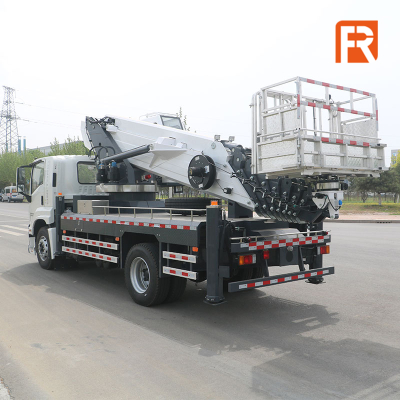
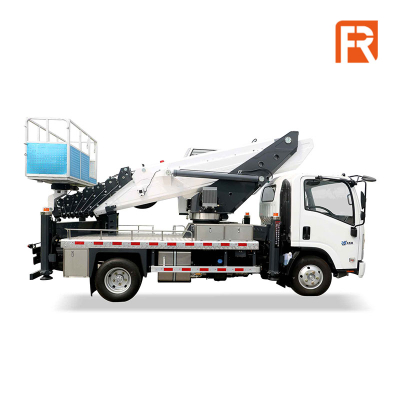
Introduction to basic parameters and common terms of aerial work platforms (AWP) in foreign markets
1. Key Specifications of Aerial Work Platforms
In foreign markets, the specifications of aerial work platforms usually follow ANSI (American National Standards Institute), ISO (International Organization for Standardization) and EN (European Standards) standards, which may vary slightly in different countries or regions. The following are common key parameters:
(1) Maximum Platform Height
Refers to the highest point that the working platform can reach, excluding the operator's standing height.
The European and American markets usually express it in feet (ft) or meters (m), for example:
40 ft (12.2 m)
60 ft (18.3 m)
80 ft (24.4 m)
(2) Maximum Working Height
Calculation method: Maximum platform height + operator height (usually assumed to be 2 m).
For example, if the platform height is 80 ft (24.4 m), the maximum working height is approximately 86 ft (26.2 m).
(3) Horizontal Outreach
Refers to the maximum distance the platform can extend on the horizontal plane, mainly applicable to **Boom Lift** aerial work vehicles.
For example:
Small boom lift: 30 ft (9.1 m)
Large boom lift: 75 ft (22.8 m)
(4) Platform Capacity / Load Capacity
Refers to the maximum weight the platform can carry, including operators, tools and materials.
Common load range:
Small model: 200 - 300 kg (440 - 660 lbs)
Medium model: 350 - 450 kg (770 - 990 lbs)
Large model: 500 - 1000 kg (1100 - 2200 lbs)
(5) Machine Weight
Refers to the total weight of the equipment itself, which directly affects the transportation and ground load-bearing capacity.
For example:
Scissor Lift: 1.5 - 6 tons
Boom Lift: 4 - 20 tons
(6) Power Source
Depending on the usage environment, the power sources of aerial work vehicles commonly found in the overseas market include:
Electric - suitable for indoor operations, zero emissions (such as JLG 1930ES)
Diesel - suitable for outdoor complex construction sites (such as Genie S-85 XC)
Hybrid - combines electric and fuel, both environmentally friendly and efficient
Liquefied petroleum gas (LPG) - used in some markets (such as the United States) to reduce carbon emissions
2. Common Terminologies of Aerial Work Platforms
| Aerial Work Platform (AWP) | A general term for all types of aerial work equipment |
| Scissor Lift | Suitable for indoor and outdoor use, stable vertical lifting |
| Telescopic Boom Lift | Straight boom extension, ideal for long-distance operations |
| Articulating Boom Lift | Articulated boom, suitable for complex environments |
| Self-Propelled AWP | Equipped with a driving system for self-movement |
| Load Capacity | Maximum weight the platform can carry |
| Working Range | The maximum reach of the platform, both horizontally and vertically |
| Outriggers | Devices used to improve equipment stability |
| Rough Terrain AWP | Designed for rugged terrain with large tires and four-wheel drive |
| Insulated AWP | Designed for the power industry with electrical insulation features |
| EN 280 | European safety standard for aerial work platforms |
| ANSI A92 | American safety standard for aerial work equipment |
3. Scope of application
Construction - large buildings, bridges, airport construction
Power & Utility - high voltage line maintenance, substation operation
Tree Trimming - urban greening, tree pruning
Industrial Maintenance - factory, warehouse, high-altitude equipment maintenance
Film Industry - high-altitude shooting, lighting installation
4. Mainstream brands and certifications in the international market
(1) Mainstream brands in Europe and the United States
JLG (USA) - Global leader in aerial work platforms with a complete product line.
Genie (USA) - Mainly provides scissor-type, boom-type and spider-type vehicles with stable quality.
Haulotte (France) - Major brand in the European market, balancing economy and performance.
Skyjack (Canada) - Famous for its scissor-type aerial work vehicles with low maintenance costs.
Snorkel (UK) - Suitable for special purposes such as explosion-proof or high load capacity.
(2) International certification
ANSI A92 (USA) - Specifies the safety standards for aerial work vehicles
EN 280 (Europe) - Safety standards applicable to the EU market
ISO 16368 - Global standard for aerial work platforms
CE certification (Europe) - Must comply with EU regulations to be sold in Europe